

If you looked up llevar in a dictionary, you’d probably get something like “to carry” or “to take” – and while that’s not wrong, it barely scratches the surface.
Llevar is one of those verbs that native speakers use constantly, in ways that can leave learners completely puzzled. Master these five meanings and you’ll unlock a huge chunk of everyday Spanish conversation.
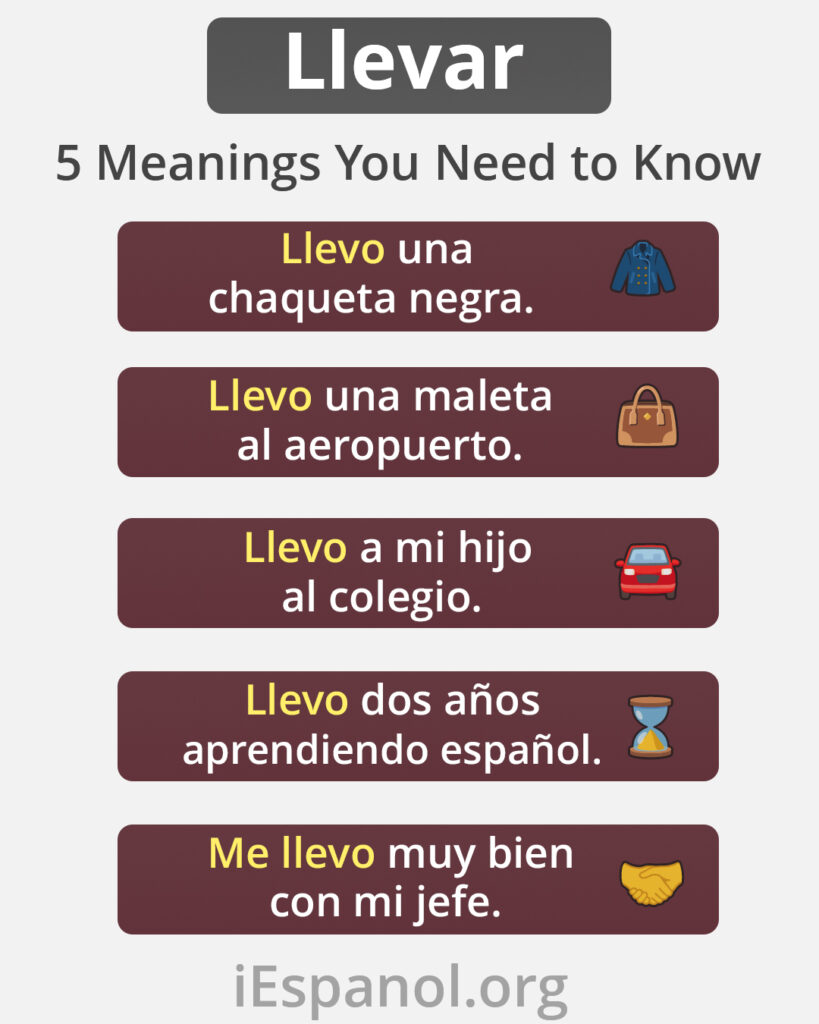
1️⃣ Llevar = to wear (clothes)
Forget vestir – in everyday Spanish, llevar is the go-to verb for talking about what you’re wearing right now.
- Llevo una chaqueta negra. – I’m wearing a black jacket.
- Hoy llevo mis zapatos nuevos. Me duelen los pies. – Today I’m wearing my new shoes. My feet hurt.
2️⃣ Llevar = to take / to carry (something with you)
When you’re bringing an object somewhere (to a party, on a trip, to the office) llevar is your verb.
- Llevo una maleta al aeropuerto. – I’m taking a suitcase to the airport.
- ¿Llevas paraguas? Parece que va a llover. – Are you taking an umbrella? It looks like it’s going to rain.
3️⃣ Llevar = to take / to drive someone somewhere
Llevar also works when you’re the one getting a person from A to B — whether you’re driving them, walking them, or dropping them off.
- Llevo a mi hijo al colegio. – I take my son to school.
- ¿Me puedes llevar a la estación? Voy a perder el tren. – Can you take me to the station? I’m going to miss my train.
4️⃣ Llevar = duration of time
This one trips up a lot of learners. In Spanish, instead of saying “I have been doing something for X time,” you use llevar + time + gerund. Once it clicks, you’ll use it all the time. Use this only if you are still doing the action now.
- Llevo dos años aprendiendo español. – I’ve been learning Spanish for two years.
- Llevamos tres horas esperando. Estoy harto. – We’ve been waiting for three hours. I’m fed up.
5️⃣ Llevarse bien = to get along
When llevar becomes reflexive and pairs up with bien (or mal), it describes the quality of your relationship with someone. Simple and incredibly useful.
- Me llevo muy bien con mi jefe. – I get along very well with my boss.
- Los dos hermanos no se llevan bien. Siempre están peleando. – The two brothers don’t get along. They’re always fighting.
As you can see, llevar is far more than “to carry.” The more you notice it in real conversations, TV shows, and podcasts, the faster these five meanings will become second nature. And the best part? Native speakers will be seriously impressed when you start using them correctly.
🗣️ Shadowing Practice
Listen to the audio and repeat each phrase immediately after the speaker, trying to match their pronunciation, intonation, and rhythm. All sentences are taken from the examples above.
✅ Daily Spanish in 1 minute
Follow us on Instagram for daily Spanish tips. Quick posts to help you learn faster.